
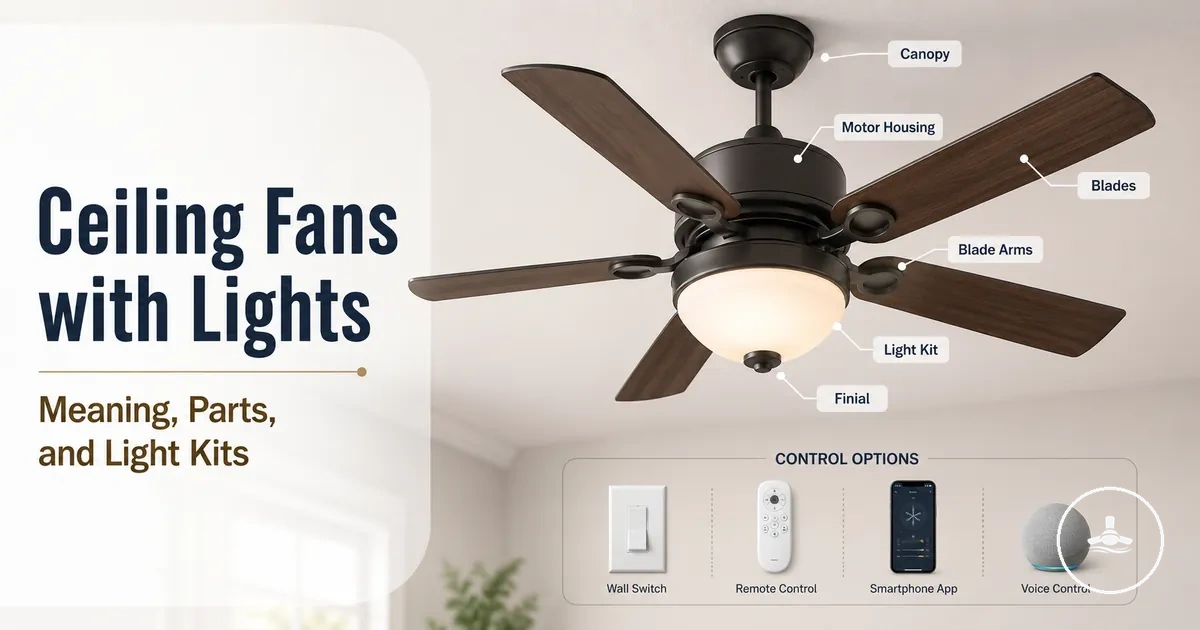
Ceiling Fans with Lights Explained
Ceiling fans with lights are ceiling-mounted fixtures that combine air movement and room lighting in one unit. A ceiling fan with light usually uses fan blades for airflow and a lighting assembly below or within the motor housing, so this page explains the meaning, main parts, light-kit forms, compatibility context, and control basics at an overview level.
An integrated light is built into the fan design, while a light kit is an attachable lighting assembly for a compatible fan. For broader room, size, lighting, and control planning, use the ceiling fans with lights guide.
A ceiling fan with light may include fan blades, a motor housing, an LED module or bulb area, a shade or diffuser, and controls such as a remote, wall switch, or pull chain. Exact replaceability, light kit fit, wiring support, and control behavior depend on the fan design, mounting point, connector, and manufacturer configuration rather than visual similarity alone.
This introduction defines the combined fixture concept only; deeper LED performance, full light-kit comparison, buying criteria, and wiring requirements belong to their own sections.
What a Ceiling Fan with Light Means
What a ceiling fan with light means is a ceiling fan that includes an integrated light or supports an attachable lighting assembly such as a light kit. The ceiling fan provides airflow, while the lighting assembly supplies overhead lighting within the same fixture.
What a Ceiling Fan with Light Means becomes easier to understand when you see how the ceiling fan and lighting assembly connect as one unit. The image below labels the main parts and shows the relationship between the fan and its light assembly.
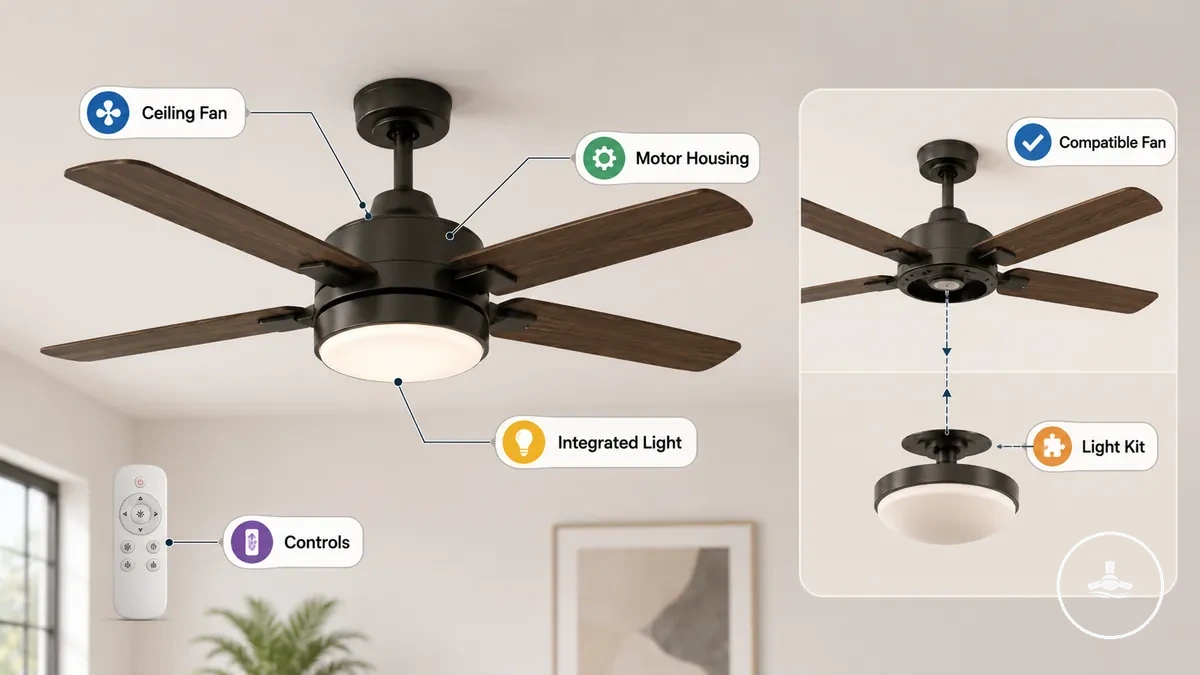
A ceiling fan with light may include a housing, controls, and either an integrated light or a light kit designed for a compatible fan. For example, one ceiling fan may be supplied with a built-in light, while another may accept an attachable light kit if its mounting point and connector support that configuration. The light source, such as an LED module or bulb, along with the shade or diffuser and control options, can vary by fan design, so compatibility depends on the specific model.
What Ceiling Fans with Lights Include
What ceiling fans with lights include usually starts with the main fan assembly and a built-in or attached lighting assembly. The exact configuration varies by fan design, but the core components work together to provide airflow, lighting, and user control.
What Ceiling Fans with Lights Include becomes easier to understand when the main components are grouped by their function. The image below labels the primary parts and shows how the fan and light assembly fit together within one fixture.
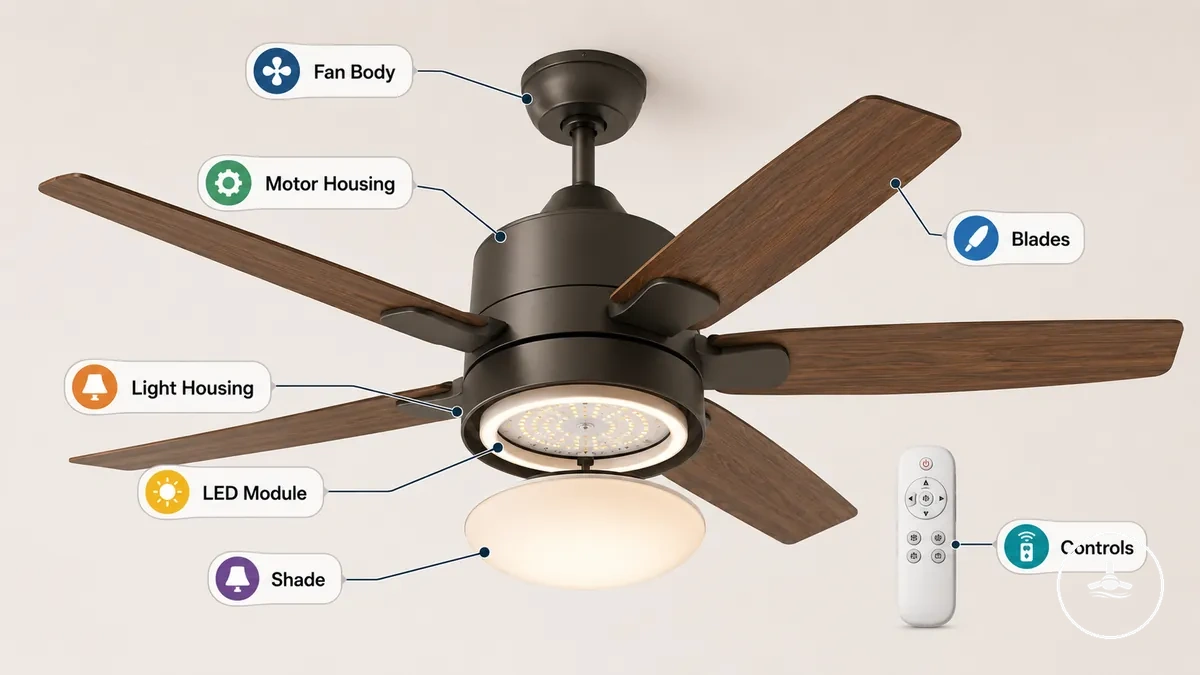
- Fan body: Supports the overall configuration and connects the main components.
- Blades: Create airflow when driven by the motor.
- Motor housing: Encloses and protects the motor.
- Light housing: Supports the lighting assembly below or within the fan body.
- Bulb or LED module: Serves as the light source, depending on the fan design.
- Shade or diffuser: Helps direct and soften the light output.
- Controls: Operate the fan, the light, or both through the available control interface.
Exact included components may vary by fan design, light kit type, and manufacturer configuration, so not every ceiling fan with light includes the same replaceable parts or accessories.
Fan Body, Blades, Motor Housing, and Light Housing
Fan body, blades, motor housing, and light housing are the structural parts that support airflow and position the lighting assembly within a ceiling fan with light. Together, these parts provide support, enclosure, balance, and placement, although their arrangement can vary by fan design.
Fan Body, Blades, Motor Housing, and Light Housing become easier to understand when each structural part is viewed by its function. The image below labels the visible parts and shows how the fan structure supports the light housing.
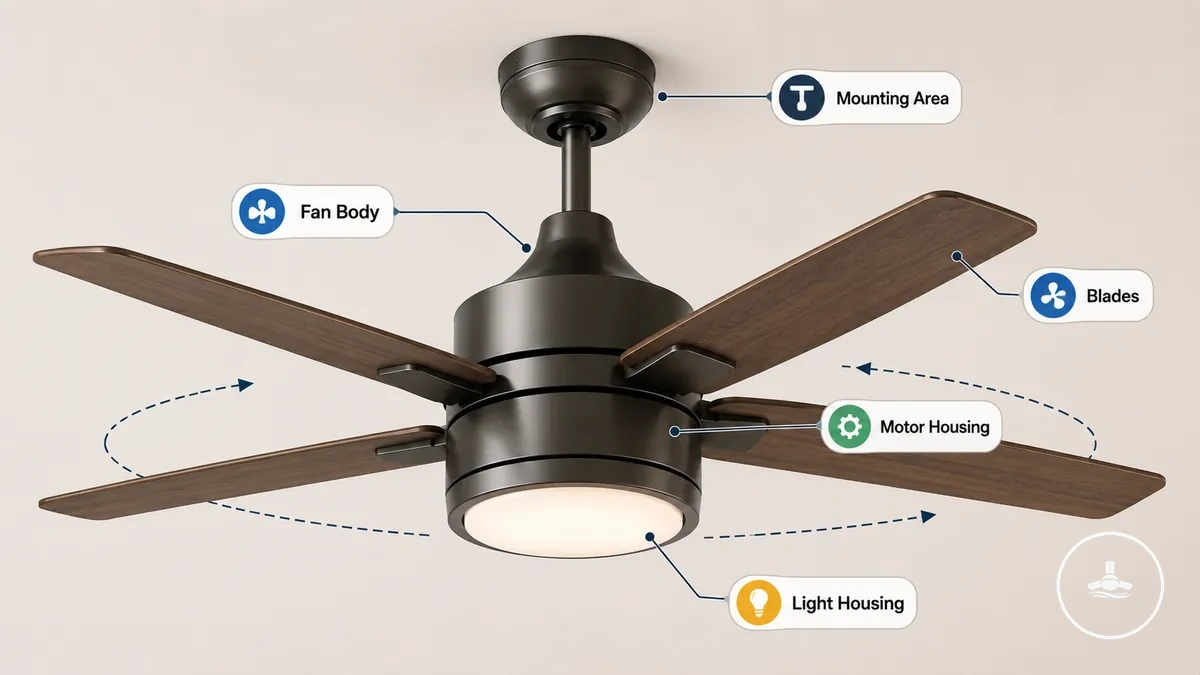
- Fan body: Supports the overall structure and connects the main parts.
- Blades: Create airflow while remaining balanced around the motor.
- Motor housing: Encloses the motor and supports the blade assembly.
- Mounting area: Positions and supports the fan assembly where it attaches.
- Light housing: Holds or frames the lighting assembly below or within the fan body, depending on the fan design.
The position, shape, and arrangement of these parts may differ between fan designs, so the structural layout can vary by model and lighting configuration.
Bulbs, LED Modules, Shades, Diffusers, and Controls
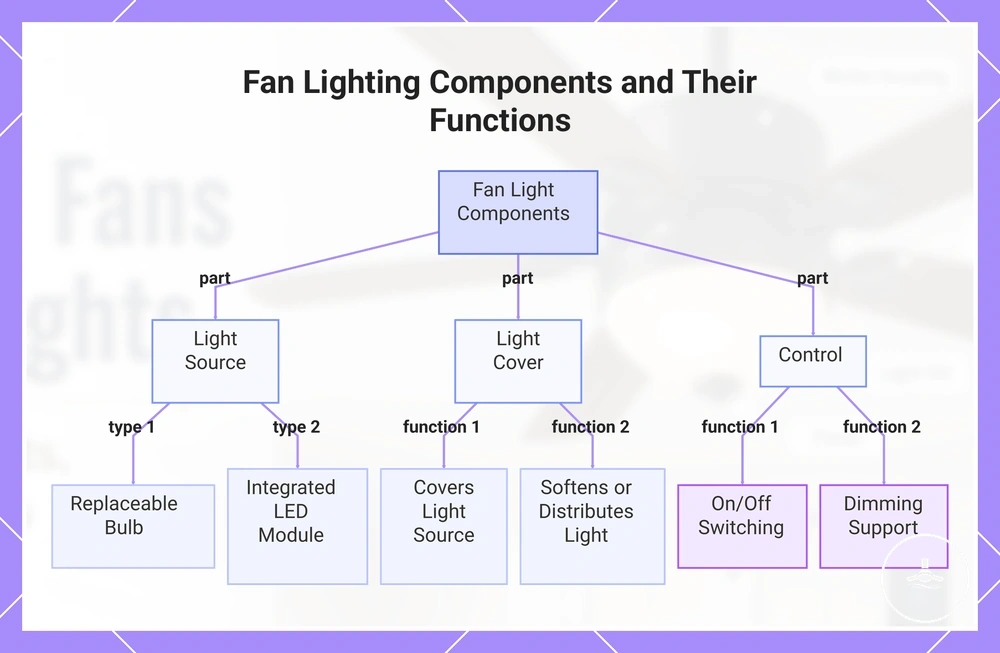
Bulbs, LED modules, shades, diffusers, and controls are the lighting and operating parts that determine how a fan light is produced, softened, and operated. Together, these parts affect light output, light distribution, and how the lighting assembly is controlled.
Bulbs, LED Modules, Shades, Diffusers, and Controls become easier to understand when each component is grouped by its function.
- Bulb or LED module: Produces the light source. The fan design may use a replaceable bulb or an integrated LED module.
- Shade or diffuser: Covers the light source and helps soften or distribute the light.
- Remote, wall control, or pull chain: Operates the fan light by switching it on or off and, in some designs, may also support functions such as dimming.
Replacement options and control features depend on the fan design and lighting configuration, so bulbs, LED modules, shades, and controls are not always interchangeable. For more information about brightness, dimming, and LED-specific features, see LED lights in ceiling fans.
This chart shows the main components that produce, soften, and control fan light, grouped by their function.
Ceiling Fan Light Kits Explained
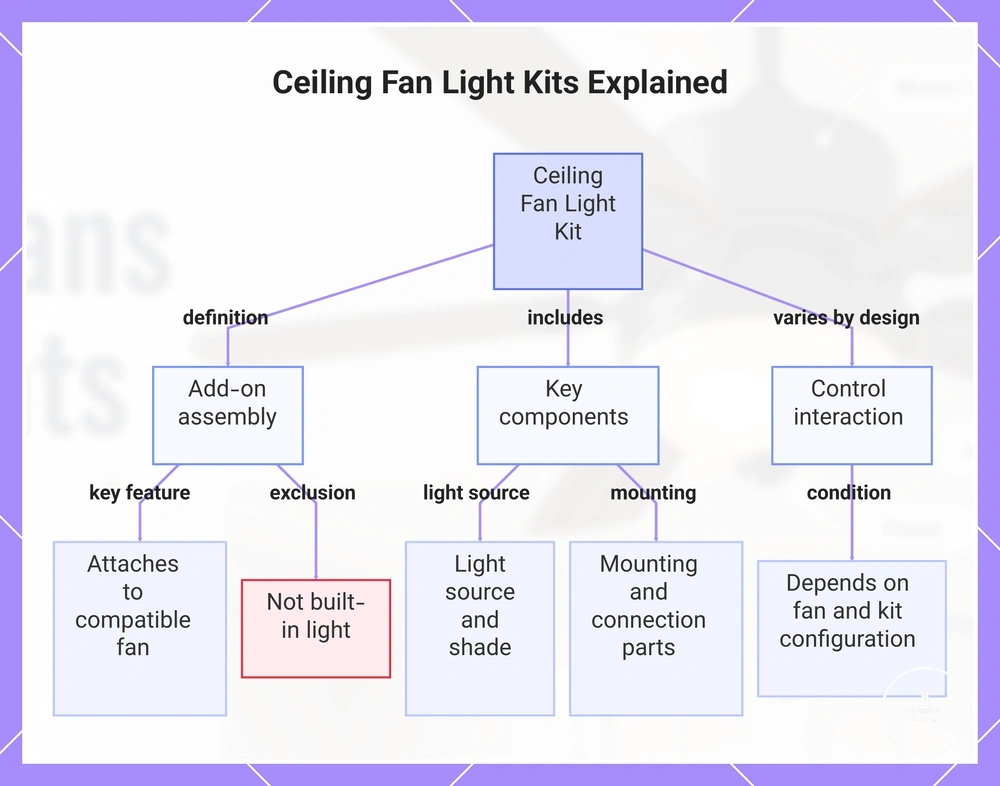
A ceiling fan light kit is a lighting assembly designed to attach to a compatible ceiling fan. Unlike an integrated light that is built into the fan, a light kit is an attachable assembly that connects to a compatible fan when its mounting point and connector support the configuration.
Ceiling Fan Light Kits Explained focuses on how the add-on assembly and its parts relate to a compatible fan. A light kit may include a kit body, wiring connector, lamp holder or LED module, shade, and mounting point that connect the lighting assembly to the fan. Control interaction can also vary by fan design, so switching, dimming, or other lighting functions depend on the fan and light kit configuration rather than the light kit alone.
- Kit body: Supports the lighting assembly.
- Wiring connector: Connects the light kit to a compatible fan.
- Lamp holder or LED module: Provides the light source, depending on the light kit design.
- Shade or diffuser: Covers the light source and helps distribute the light.
- Mounting point: Positions and secures the light kit on a compatible fan.
This section explains the add-on concept of a ceiling fan light kit rather than detailed choice, comparison, compatibility verification, or installation guidance.
This chart shows the definition, key components, and control interaction of a ceiling fan light kit as an add-on assembly.
Add-On Light Kits for Fans Without Lights
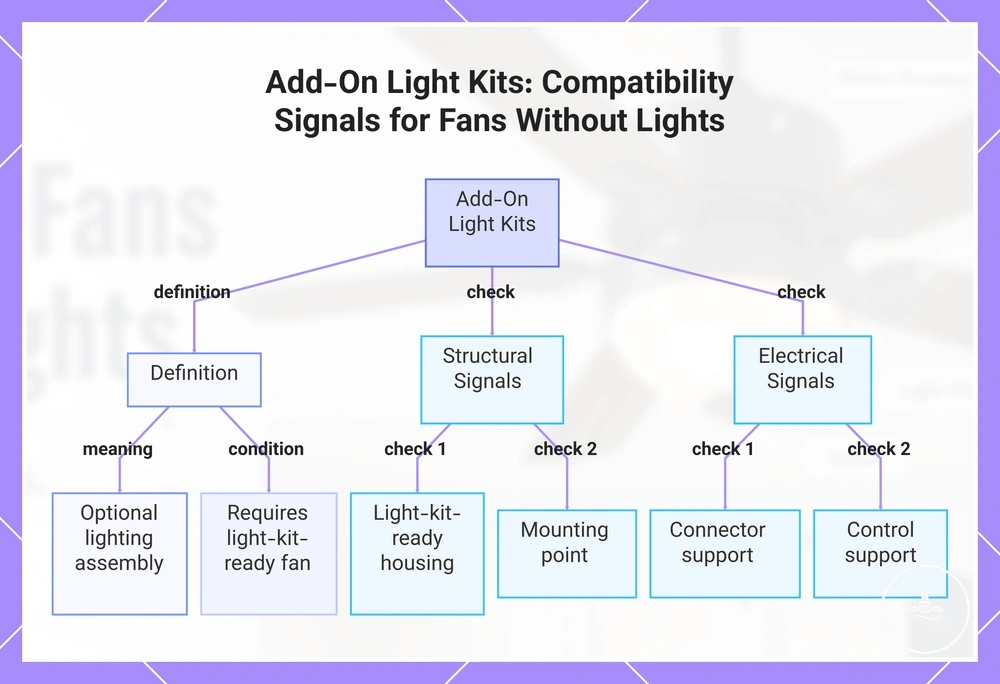
Add-on light kits for fans without lights are optional lighting assemblies designed for a ceiling fan that was built to accept one. A ceiling fan without an integrated light can use a light kit only when the compatible fan provides the required mounting point, connector, and support for the lighting assembly.
For a fan without a light, these compatibility signals help identify whether it may be a light-kit-ready design:
- Light-kit-ready housing: The fan housing is designed to accept an attachable lighting assembly.
- Mounting point: A dedicated attachment point supports the light kit.
- Connector support: An internal connector may be provided for the light kit, depending on the fan design.
- Control support: Fan controls may support the added light, although available functions depend on the compatible fan.
- Shade clearance: The light kit should match the available space beneath the fan housing.
For example, a ceiling fan with a removable bottom cap may reveal a light-kit connection when the model was designed for an optional lighting assembly. This section explains when a fan without a light can be a light-kit candidate and does not cover installation or universal upgrade claims.
This chart shows the definition of add-on light kits and the key structural and electrical signals that indicate a ceiling fan without a light is compatible with an optional lighting assembly, but it does not cover installation procedures or universal upgrade claims.
Replacement Light Kits for Existing Fan Lights
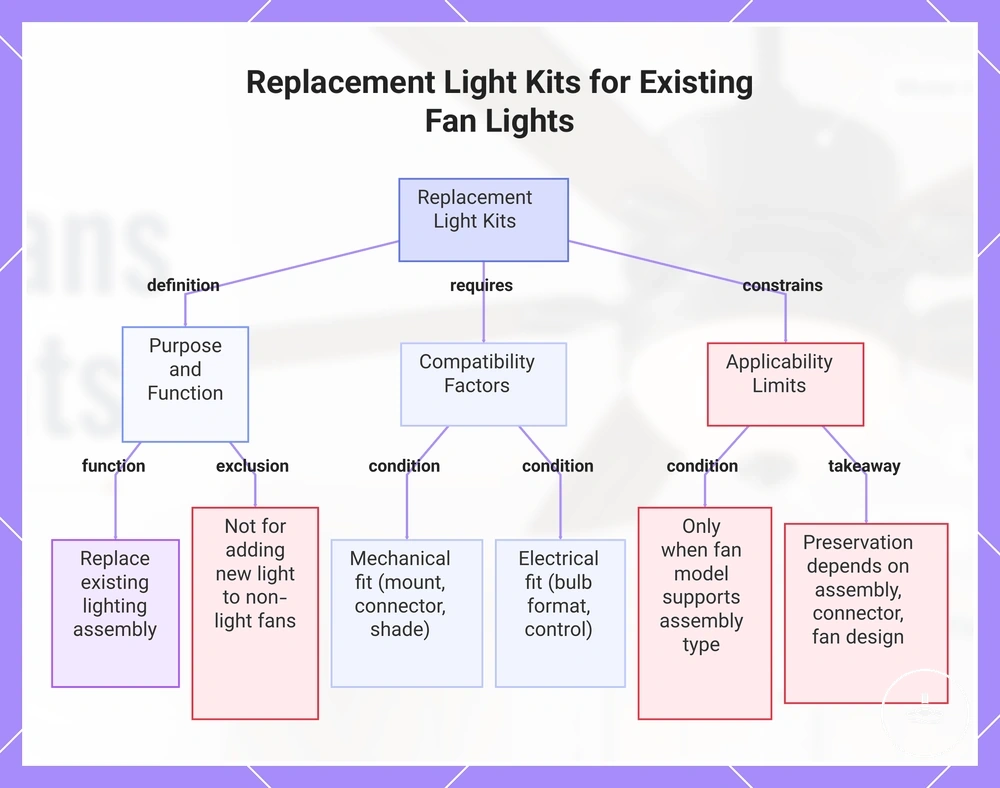
Replacement light kits for existing fan lights are part-level replacements for an existing light assembly when the ceiling fan design supports that replacement. Their function is to replace the current lighting assembly rather than add a new light to a ceiling fan that was not originally designed for one.
Replacement depends on the existing light assembly and the fan model. These conditions help determine whether a replacement light kit may be suitable:
- Existing light assembly type: The replacement light kit should correspond with the original lighting assembly.
- Mounting pattern: The attachment points should match the existing light assembly.
- Connector fit: The connector should correspond with the existing fan light connection.
- Shade fit: The shade should suit the existing housing and available clearance.
- LED module or bulb format: The replacement light source depends on the original lighting assembly design.
- Control compatibility: Fan light controls may continue to operate as intended when the replacement light kit is compatible with the fan design.
Replacement light kits apply only when the fan model supports that type of lighting assembly. Whether the replacement preserves the original function or control behavior depends on the existing assembly, connector, and fan design.
This chart shows the definition, compatibility factors, and applicability limits of replacement light kits for ceiling fans that already have a light assembly.
Integrated Lights and Light Kits as Two Lighting Forms
Integrated lights and light kits as two lighting forms represent two different ways a ceiling fan can provide lighting. An integrated light is built into the fan, while a light kit is a separate lighting assembly designed for a compatible fan.
Integrated Lights and Light Kits as Two Lighting Forms can be compared by structure, replaceability, appearance, and compatibility. These differences clarify how each lighting form relates to the ceiling fan without suggesting that either option is always preferable.
| Feature | Integrated Light | Light Kit |
|---|---|---|
| Form | Built into the ceiling fan as part of the original lighting assembly. | Separate lighting assembly that attaches to a compatible fan. |
| Replaceable | Replaceable parts may depend on the fan design and lighting assembly. | The light kit may be replaced when the fan model supports that configuration. |
| Appearance | Often follows the original fan housing design. | Appearance may vary depending on the compatible light kit and fan design. |
| Compatibility | Compatibility is determined by the original fan design. | Compatibility depends on the mounting point, connector, and fan model. |
| Trade-off | Provides a built-in lighting assembly. | May offer more design flexibility when the ceiling fan is designed to accept a light kit. |
These differences define two structural lighting forms rather than a recommendation. For a more detailed comparison, see integrated lights versus light kits.
Built-In Integrated Light Assemblies
Built-in integrated light assemblies are lighting systems designed into a ceiling fan rather than added as a separate light kit. The integrated light forms part of the original lighting assembly and is housed within the fan design.
Built-in integrated light assemblies typically include a fixed housing, a light source such as an LED module or bulb area, a diffuser or shade, and a control path connected to the ceiling fan controls. Unlike a light kit, these parts are integrated into the fan structure, although access to the LED module, bulb area, or diffuser may vary by fan design. For example, one compatible fan may allow the diffuser to be removed for maintenance, while another may use a different integrated lighting assembly.
Replaceability depends on the compatible fan and its lighting assembly rather than the integrated design alone. An integrated light should not be assumed to have the same replacement options across all ceiling fan models.
Separate Light Kits Attached to Compatible Fans
Separate light kits attached to compatible fans are lighting assemblies that connect to a ceiling fan only when the fan is designed to accept the kit. Unlike an integrated light that is built into the fan, a light kit attaches as a separate lighting assembly to a compatible fan.
Separate light kits attached to compatible fans depend on multiple fit signals working together rather than a single feature. These conditions help determine whether a light kit may suit a compatible fan:
- Attachment point: The ceiling fan should provide a mounting point designed for the light kit.
- Connector availability: The fan should have a compatible connector for the lighting assembly.
- Housing match: The light kit housing should correspond with the fan design.
- Shade style: The shade should suit the light kit and the available space beneath the fan.
- Control path: Light operation depends on the compatible fan and its control configuration.
For example, a compatible fan may support an attachable light kit when its mounting point and connector are provided by the original fan design. Compatibility depends on the specific fan model, so separate light kits should not be assumed to fit every ceiling fan.
Replaceable Parts in Ceiling Fan Light Assemblies
Replaceable parts in ceiling fan light assemblies depend on the fan design and the type of lighting assembly. Some parts may be replaced individually, while other parts can only be replaced when the ceiling fan and its light assembly support that option.
Replaceable Parts in Ceiling Fan Light Assemblies are clearer when each part is organized by replaceability condition and practical caution. The table below maps each part to the condition that may allow replacement and the effect that condition has on fit or function.
| Part | Replaceability Condition | Practical Caution |
|---|---|---|
| Bulb | May be replaceable when the lighting assembly uses replaceable bulbs. | Match the bulb type supported by the fan light. |
| LED module | May be replaceable only when the fan design allows module replacement. | Some integrated LED assemblies may require replacement of the complete light module. |
| Shade or diffuser | May be replaced when the housing and mounting design are compatible. | Shape and attachment style should correspond with the existing light assembly. |
| Socket | Replacement depends on the lighting assembly design and access to the part. | Socket style may vary between fan models. |
| Pull chain | May be replaceable when the control mechanism supports it. | Replacement depends on the control design. |
| Remote receiver | May be replaced when the receiver is a separate compatible component. | Control behavior depends on the fan design and compatible receiver. |
| Light-kit housing | May be replaceable when the compatible fan supports that lighting assembly. | Housing compatibility depends on the mounting point and fan design. |
Integrated and attachable lighting assemblies can have different replaceability limits, so the function and effect of replacing a part depend on the specific ceiling fan and lighting assembly rather than a single rule.
Basic Compatibility Conditions for Ceiling Fan Light Kits
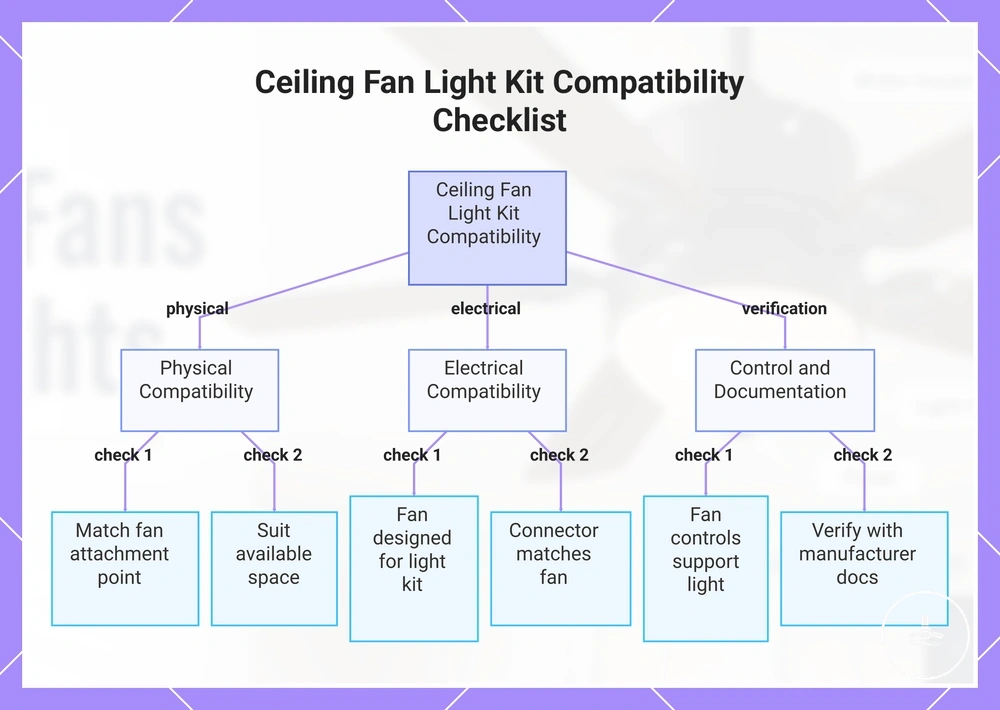
Basic compatibility conditions for ceiling fan light kits depend on multiple matching conditions rather than appearance alone. A light kit may work only when the compatible fan supports the kit and the mounting point, connector, size, and control support align with the fan design.
Basic Compatibility Conditions for Ceiling Fan Light Kits become clearer when each condition is checked separately. The checklist below identifies the main criteria that help verify compatibility without assuming that a similar-looking light kit will fit.
- Fan readiness: A compatible fan should be designed to support a light kit.
- Mounting point: The light kit should match the fan's attachment point and housing arrangement.
- Electrical connector: The connector should correspond with the compatible fan and its lighting assembly.
- Shade and size fit: Shade clearance and light-kit dimensions should suit the available space beneath the fan.
- Control support: Fan controls should support the attached lighting assembly when that function is available.
- Manufacturer instructions: Model-specific documentation can help verify compatibility because support may vary between fan designs.
These conditions should be considered together because meeting only one criterion does not confirm compatibility. For broader evaluation criteria, see features to compare before choosing.
This chart groups the main compatibility conditions for ceiling fan light kits into physical, electrical, and verification checks.
Fan Support for a Light Kit
Fan support for a light kit depends on whether a compatible fan is designed or intended to accept an attachable lighting assembly. Support should be verified before considering a light kit because appearance alone does not confirm compatibility.
The support signals below help verify whether a ceiling fan may be prepared for a light kit:
- Light-kit-ready labeling: Product information or manufacturer instructions may indicate that the fan supports a light kit.
- Removable cap: A removable bottom cap may provide access to a mounting point, but its presence alone does not confirm compatibility.
- Mounting point: A compatible fan should provide a mounting point designed for the lighting assembly.
- Connector availability: A suitable connector may be present when the fan is designed to support a light kit.
- Control support: Fan controls should support the added light when that function is available for the fan design.
- Manufacturer instructions: Model-specific documentation can help verify whether the fan is intended to accept a compatible light kit.
A ceiling fan that does not indicate support for a light kit should not be treated as a simple light-kit candidate, even if its housing or overall shape appears similar to compatible models.
Mounting, Connector, Shade, and Control Fit
Mounting, connector, shade, and control fit work together after basic fan support has been confirmed for a compatible fan. A light kit may only be compatible when these fit factors align with the fan design and lighting assembly.
The fit factors below should be considered together because each condition can affect compatibility independently:
- Mounting point: The light kit should match the fan's mounting pattern so the lighting assembly can attach correctly.
- Connector: The connector should correspond with the compatible fan to allow the lighting assembly to connect.
- Shade clearance: The shade should clear the fan housing and surrounding light assembly without relying on visual similarity alone.
- Bulb or LED format: The light source should match the lighting assembly supported by the fan design.
- Remote control, wall control, and switch behavior: Control support depends on whether the fan and light kit are designed to operate together.
A light kit may fit the mounting point but still have a connector or control mismatch. Manufacturer instructions can help verify physical fit and control compatibility before treating a light kit as suitable for a specific ceiling fan.
Wiring and Control Context for Ceiling Fans with Lights
Wiring and control context for ceiling fans with lights explains why a ceiling fan with light may operate differently depending on its control configuration. This is a conceptual overview of how controls relate to the fan and lighting assembly, not installation instructions.
Wiring and control context for ceiling fans with lights becomes easier to understand when common control configurations are compared. The control setup can affect how the fan light, fan motor, housing components, and controls operate together, although the available functions depend on the fan design and installed configuration.
| Control Configuration | Conceptual Effect |
|---|---|
| Single switch | The ceiling fan with light may share one wall switch, depending on the installed configuration. |
| Separate fan and light controls | Fan and lighting assembly operation may be controlled independently when separate controls are available. |
| Remote receiver | A remote receiver may manage fan and light functions through compatible controls. |
| Wall control | Wall controls may support selected fan and light functions when compatible with the configuration. |
| Pull chain | A pull chain may operate the fan, the light, or both, depending on the fan design. |
| Dimming support | Dimming capability depends on the light source, controls, and overall configuration. |
| Special wiring uncertainty | Operation may vary when the installed wiring arrangement differs from the intended control configuration. |
Complex wiring requirements should be treated as a separate installation question rather than part of the definition of a ceiling fan with light or its components.