Ceiling Fans with Lights for Sloped and Vaulted Ceilings: Compatibility and Fit
Ceiling fans with lights for sloped and vaulted ceilings depend on compatibility between the ceiling slope, mounting system, clearance, airflow needs, and lighting distribution. A sloped ceiling or vaulted ceiling changes how the fan hangs, how the blades rotate in the room, and how the light sits below the fixture height. The main question is not whether every angled ceiling can take a fan with a light, but whether the ceiling geometry can support a stable and balanced setup. That compatibility logic comes before style, control type, or product preference.
Ceiling slope is the primary constraint because it can affect stability, balance, airflow direction, and lighting spread at the same time. A steeper incline ceiling may need a mounting bracket, angled adapter, or downrod configuration that keeps the fan positioned correctly rather than tilted with the ceiling plane. Clearance also becomes more sensitive because blade rotation and fixture height may sit closer to one side of the ceiling or room. Airflow can feel less efficient when the fan position does not match the room volume, while lighting distribution may vary when the fixture is suspended unevenly in a vaulted space. Selection should therefore start with slope, support, and clearance before narrowing the choices.
For a room with an angled ceiling, the fit decision usually moves through a few connected checks: ceiling angle, mounting approach, downrod need, blade clearance, light position, and structural support. A low angled ceiling may create different limits from a high vaulted ceiling, even when both are described as sloped. A fan that appears suitable in shape may still depend on the correct mounting system and enough space for safe rotation and useful light spread. The next sections break down how ceiling geometry, pitch, mounting systems, clearance, installation readiness, and selection criteria shape compatibility for ceiling fans with lights in sloped and vaulted spaces.
How ceiling fans with lights work on sloped and vaulted ceilings: compatibility fundamentals and constraints
Ceiling angle is the primary factor that influences how ceiling fans with lights work on sloped and vaulted ceilings. Ceiling geometry affects airflow direction, rotational balance, lighting distribution, and overall compatibility because it changes how the fan is positioned within the room. As the ceiling angle changes, the relationship between the mounting point, blade rotation, and fixture height can also change. Understanding this relationship provides the foundation for evaluating compatibility before considering more specific selection criteria.
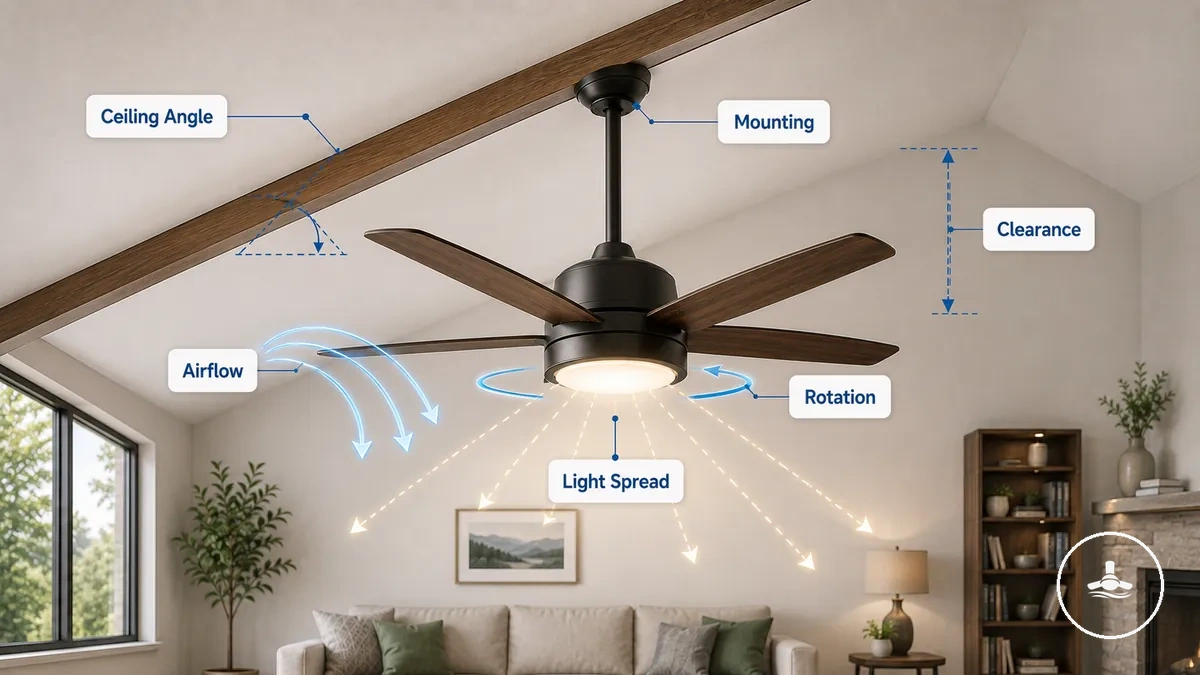
Airflow direction and rotational balance are influenced by ceiling geometry rather than by the fan alone. When ceiling angles change the fan's position, airflow may spread differently throughout the room, while stable rotation can depend on the mounting system, available clearance, and overall support. Lighting distribution may also vary because fixture height and ceiling angle can influence how light reaches surrounding areas. These factors do not necessarily prevent compatibility, but they can affect suitability under different slope conditions. Together, ceiling geometry, airflow behavior, rotational stability, and lighting distribution determine how well a fan with a light may perform in a sloped or vaulted environment.
These compatibility fundamentals provide the context for evaluating more specific selection criteria in the following sections. For broader background on related fan types and configurations, see the ceiling fans with lights guide.
Ceiling angle limits and pitch requirements for safe ceiling fan installation with lights
Ceiling pitch is the primary criterion for determining whether a ceiling fan with lights may be suitable for a sloped or vaulted ceiling. Rather than assuming universal compatibility, ceiling pitch establishes the compatibility range by influencing mounting tolerance, structural support, and the available clearance threshold. As the slope changes, the fan's alignment and overall stability may also change. The suitability of a mounting system therefore depends on how well it adapts to the ceiling angle instead of the fan alone. Evaluating ceiling pitch first provides a practical basis for assessing installation feasibility.
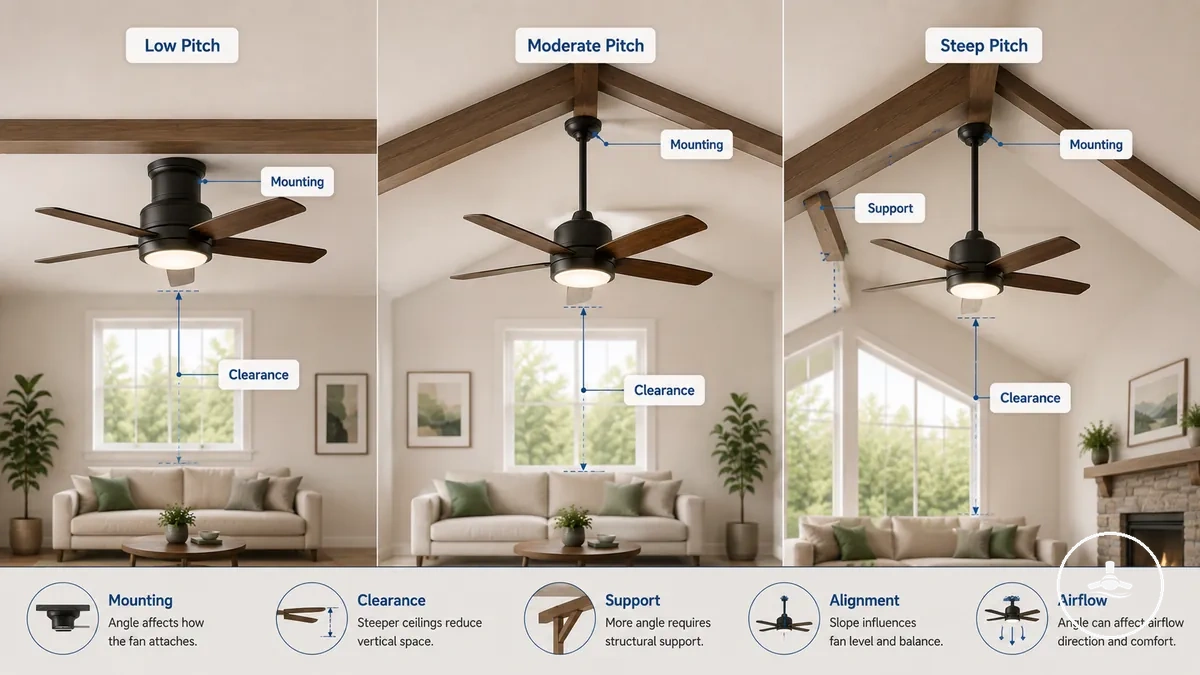
Ceiling pitch should be interpreted as a compatibility range rather than a fixed limit. Low slopes may require fewer mounting adjustments, while moderate slopes can place greater emphasis on mounting tolerance and structural support. Steeper slopes may increase sensitivity to clearance thresholds and balance, depending on the ceiling geometry and mounting system. As the ceiling angle becomes more pronounced, system adaptability becomes a more significant factor in maintaining compatibility. Considering slope range together with mounting tolerance, structural support, and clearance provides a more reliable evaluation than relying on ceiling angle alone.
In rooms with noticeably angled or vaulted ceilings, ceiling pitch should be assessed alongside structural support and available clearance before determining suitability. Compatibility depends on the combined effect of these criteria rather than on a single characteristic. For a broader assessment of these factors, refer to clearance and mounting safety.
Choosing mounting systems for sloped and vaulted ceiling fans with lights
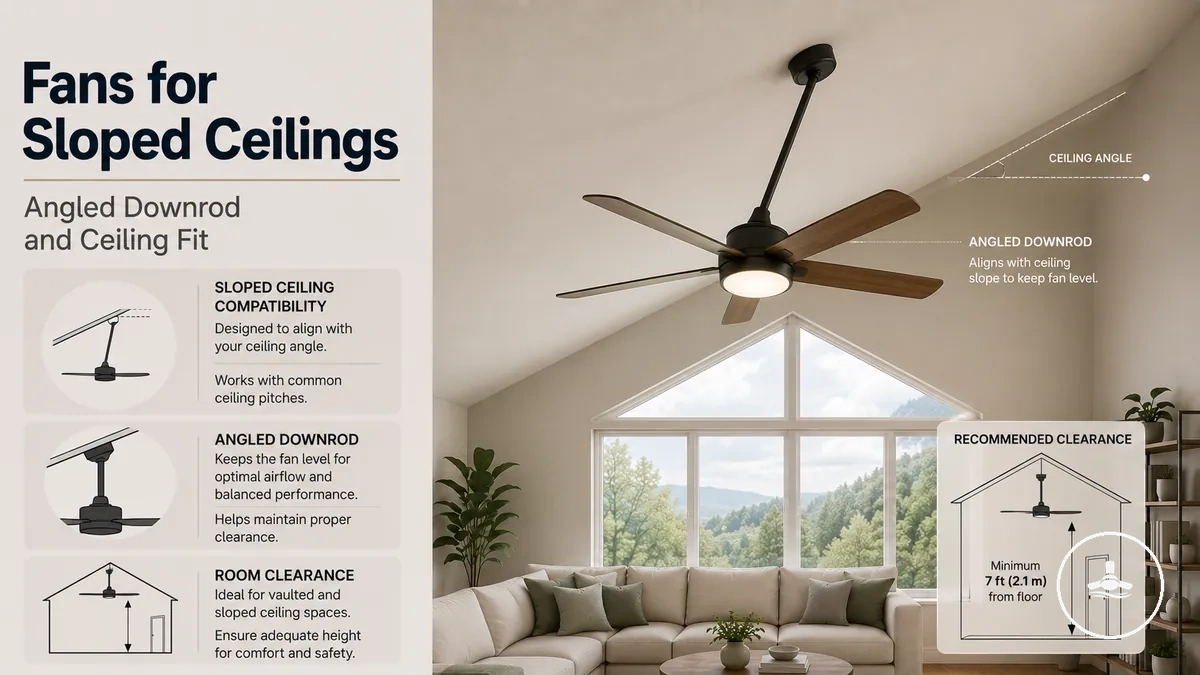
Mounting system compatibility depends on selecting a system that can maintain stable operation on a sloped or vaulted ceiling. The mounting system determines how the ceiling fan with lights adapts to the ceiling angle, which can influence alignment stability, airflow distribution, and structural adaptation. Different mounting systems are designed to accommodate different ceiling conditions rather than serving the same purpose. Evaluating the mounting system first helps determine whether the fan can adapt appropriately to the installation environment.
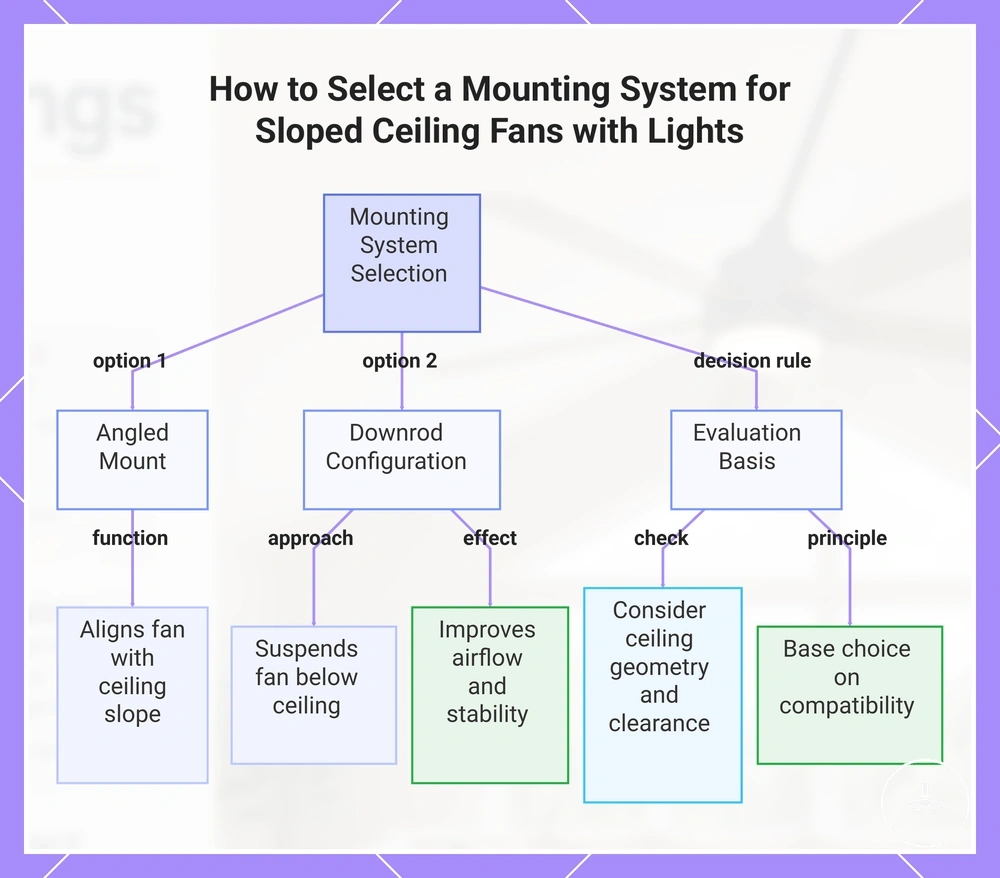
Angled mounting systems and downrod configurations represent two distinct compatibility approaches. An angled mount is intended to accommodate the ceiling slope at the mounting point, helping the fan remain properly aligned with the installation geometry. A downrod configuration suspends the fan farther below the ceiling, which may improve alignment stability and airflow distribution when ceiling height and slope require additional separation. The suitability of either approach depends on ceiling geometry, structural adaptation, available clearance, and the compatibility of the mounting system with the installation conditions. Neither approach is universally preferable because each addresses different installation requirements.
Selecting between an angled mount and a downrod configuration should be based on compatibility rather than preference. Considering alignment stability, airflow distribution, structural adaptation, and the characteristics of the ceiling together provides a more reliable basis for evaluating which mounting system may be appropriate for a particular sloped or vaulted ceiling.
This chart compares angled mounts and downrod configurations for installing ceiling fans on sloped ceilings and highlights key evaluation factors.
Angled ceiling mounts and adapter kits for sloped ceiling installation
Angled mounts and adapter kits are compatibility mechanisms that help a ceiling fan with light maintain a more level orientation on a sloped ceiling. An angled mount adjusts the connection between the ceiling and the fan so the fan body is not forced to follow the ceiling plane directly. An adapter kit can provide leveling support when the standard mounting system does not suit the ceiling angle. This alignment correction may help reduce tilt-related imbalance and support steadier fan movement under slope conditions.
The functional value of an angled mount is its ability to manage angle effects before they influence airflow consistency and stability. When the fan hangs closer to level, blade rotation may operate with less tilt-related stress, and airflow distribution can remain more predictable within the room. The result is not guaranteed perfect leveling, because compatibility still depends on the ceiling geometry, mounting system, support conditions, and available clearance. Angled mounts and adapter kits should therefore be evaluated as alignment-support components rather than universal fixes for every sloped ceiling.
Downrod selection and length adjustment for vaulted ceiling airflow and balance
Downrod selection depends on choosing a downrod length that remains proportionate to the ceiling height and the airflow requirements of the room. Downrod length influences clearance height, airflow reach, and rotational efficiency because it determines how the fan is positioned within a vaulted ceiling space. Rather than relying on a fixed length, the appropriate downrod configuration typically depends on the relationship between ceiling height, available clearance, and the desired airflow performance.
A downrod that is shorter than the room conditions require may reduce airflow reach by positioning the fan too close to the ceiling, while an excessively long downrod may alter clearance height and influence operational balance. Comfort levels and rotational efficiency can therefore depend on maintaining an appropriate relationship between ceiling height, fan position, and surrounding space. Selecting downrod length is best treated as a balance between clearance, airflow performance, and stable operation instead of applying a single sizing approach to every vaulted ceiling.
Clearance and safety requirements for ceiling fans with lights on angled ceilings
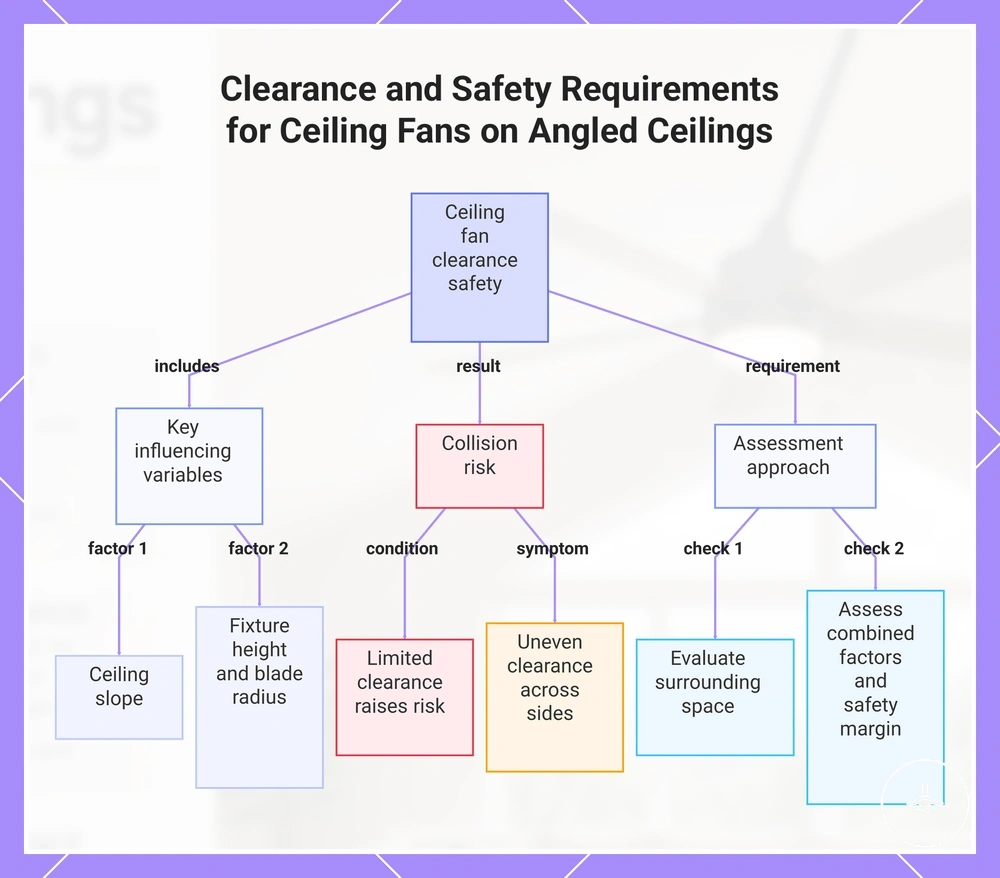
Clearance is a safety-sensitive condition that depends on the relationship between ceiling slope, fixture height, blade radius, and installation positioning. On an angled ceiling, these factors can influence collision risk because the available space around the rotating blades and light fixture may vary across different parts of the installation. Maintaining an appropriate safety margin therefore requires evaluating the surrounding space rather than relying on ceiling angle alone.
Ceiling slope can change how blade radius and fixture height relate to nearby surfaces. As the angle becomes steeper, the clearance available on one side of the fan may differ from the other, which can increase the need for careful spatial evaluation. When clearance is limited, collision risk may become a greater consideration, while adequate spacing can help support more consistent operation under angled ceiling geometry.
Clearance assessment should be based on the combined effect of ceiling slope, fixture height, blade radius, and the available safety margin within the room. Tighter slopes often require more careful consideration because the surrounding space can vary with the installation position. For broader guidance on evaluating these conditions, see clearance and mounting safety.
This chart shows the key variables influencing clearance safety, the resulting collision risk, and the required assessment approach for ceiling fans on angled ceilings.
Blade clearance near sloped rooflines and angled ceiling geometry
Blade clearance depends on how the blade radius interacts with the roofline angle to create variable clearance zones during rotation. On a sloped ceiling, the distance between the rotating blades and the ceiling surface may not remain uniform because the ceiling geometry changes spatial proximity around the fan. As a result, the available safety margin can vary across the rotation path instead of remaining consistent in every direction.
Changes in roofline angle can create areas where blade clearance is tighter and other areas where more space is available. This uneven spatial proximity may influence how the safety margin is evaluated, especially where the ceiling slope approaches the blade radius more closely. Interpreting blade clearance as a variable relationship between rotation, roofline angle, and surrounding space provides a more reliable assessment than assuming the same clearance zone exists throughout the entire blade path.
Lighting clearance and fixture positioning under vaulted ceilings
Lighting clearance depends on the relationship between the lighting fixture, vertical clearance, and ceiling slope within a vaulted ceiling environment. An integrated lighting fixture can influence how available space is perceived below the fan, while fixture height may affect obstruction risk where the ceiling angle narrows the surrounding space. Evaluating lighting clearance therefore requires considering both fixture positioning and ceiling geometry rather than the lighting fixture alone.
Ceiling slope can change how a lighting fixture distributes light and how close the fixture appears to nearby surfaces, creating different patterns of spatial sensitivity throughout the room. As fixture height and ceiling angle interact, light distribution effectiveness and perceived vertical clearance may vary, which can influence the evaluation of spatial safety. Interpreting lighting clearance as a relationship between fixture positioning, ceiling slope, and surrounding space provides a more reliable assessment than assuming uniform conditions throughout a vaulted ceiling.
Installation considerations for vaulted and sloped ceiling fan setups
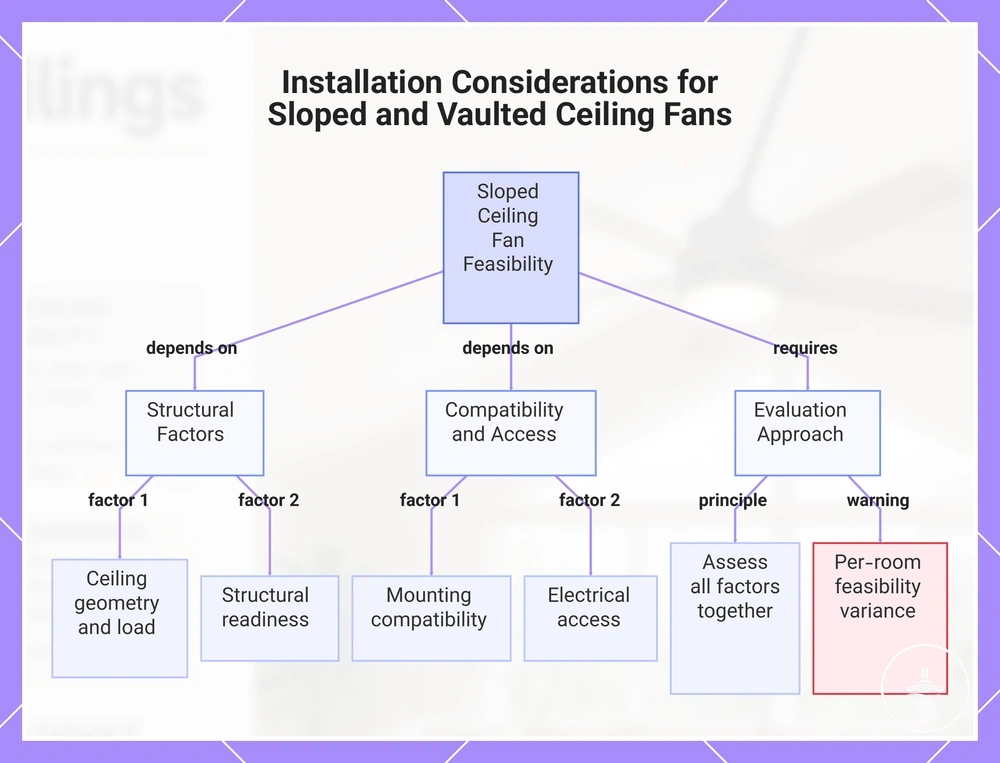
Installation feasibility depends on structural readiness, mounting compatibility, electrical access, load capacity, and ceiling geometry rather than on the fan alone. Before suitability can be assessed, the supporting structure and ceiling configuration should be evaluated together because an angled ceiling may introduce different mounting and support requirements. A sloped or vaulted ceiling can therefore influence whether a particular installation approach is appropriate.
Mounting compatibility and electrical access should be considered alongside structural readiness instead of being evaluated independently. Even when the ceiling structure appears suitable, electrical accessibility and the intended mounting arrangement may influence overall feasibility. For broader electrical considerations, see wiring requirements for ceiling fan lights.
Pre-installation evaluation is most reliable when ceiling geometry, load capacity, mounting compatibility, and electrical access are considered together. Installation suitability may vary between rooms with similar ceiling styles because structural support and existing electrical arrangements can differ, so feasibility should be assessed before selecting an installation approach.
This chart shows the key factors and evaluation approach for determining the feasibility of installing a ceiling fan on a sloped or vaulted ceiling.
Ceiling electrical box support and structural mounting requirements for angled installations
Structural compatibility depends on whether the electrical box, support strength, and load capacity are appropriate for a ceiling fan installation on an angled ceiling. The electrical box forms the primary structural support for the fixture, while structural reinforcement may be needed when the existing support arrangement is not suitable for the intended load. Evaluating these structural conditions before installation provides a more reliable assessment of mounting feasibility.
Load capacity alignment and weight distribution should be assessed together because they influence how forces are transferred through the electrical box and supporting structure over time. On an angled ceiling, ceiling geometry may affect how fixture weight is distributed, making support strength and structural reinforcement important considerations for long-term mounting stability. Evaluating the electrical box, load capacity, structural reinforcement, and weight distribution as a connected system provides a more reliable basis for determining structural compatibility than considering each element separately.
Selecting the right ceiling fan with light configuration for sloped and vaulted spaces
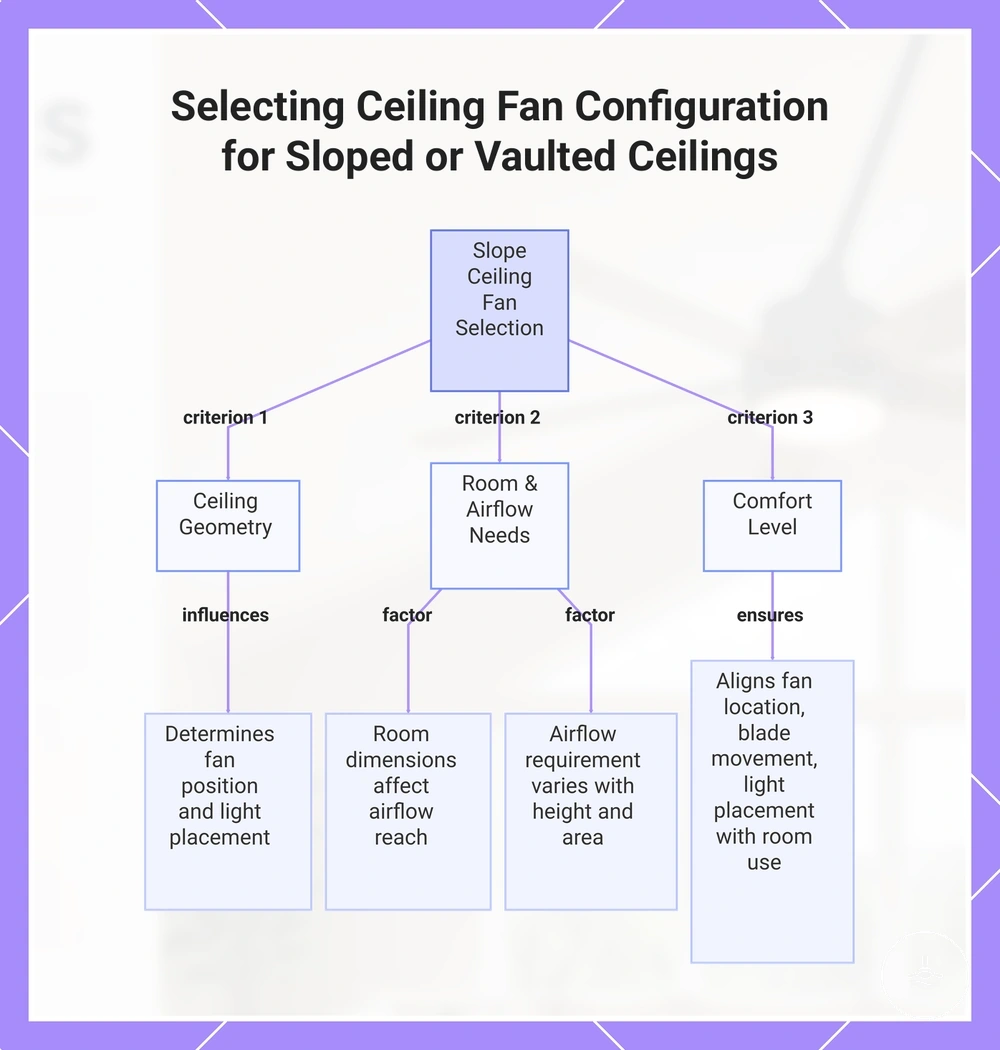
Selection should match the ceiling fan with light configuration to the ceiling geometry, room dimensions, and airflow requirement of the space. A sloped or vaulted ceiling can change how the fan is positioned, how air moves through the room, and how the light sits within the vertical space. The right configuration type therefore depends on a geometry match rather than on a single universal option. Selection criteria should begin with the room shape and ceiling condition before narrowing toward comfort level expectations.
Room dimensions and airflow requirement work together because a configuration that suits one vaulted space may not suit another room with a different height, width, or usable area. A higher ceiling may require a configuration that supports better airflow reach, while a tighter angled space may place more emphasis on clearance and positioning. Comfort level can also vary when the fan location, blade movement, and light placement do not align with how the room is used. The selection process should therefore evaluate spatial constraints and airflow needs as connected criteria.
A practical configuration choice comes from comparing ceiling geometry, room dimensions, airflow requirement, and expected comfort level without assuming one setup is suitable for every sloped or vaulted space. The configuration type should support the available space, the intended airflow pattern, and the way the fan with light will sit in the room. For deeper sizing context, review blade span and room coverage.
This chart shows the key criteria for selecting a ceiling fan with light configuration for sloped or vaulted ceilings, starting with ceiling geometry, then room dimensions and airflow requirements, and finally comfort level.
Common mistakes when installing ceiling fans with lights on sloped and vaulted ceilings
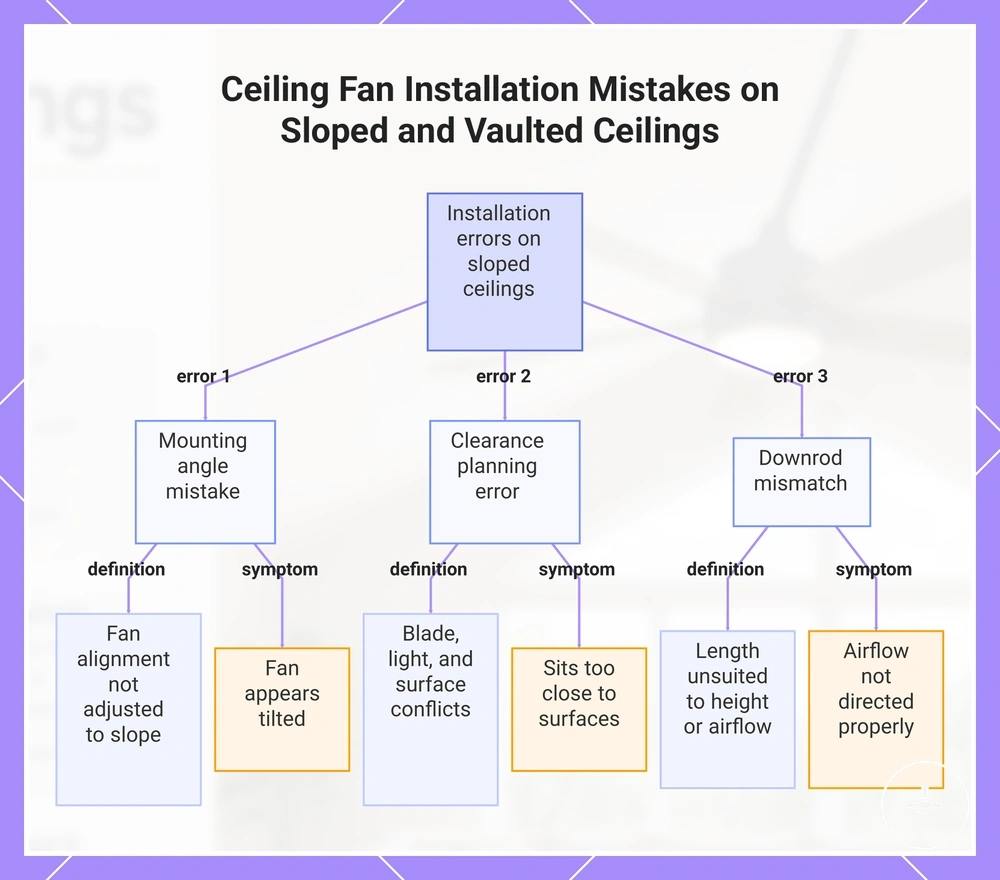
Installation errors on sloped and vaulted ceilings often come from configuration mismatches rather than the fan itself. An incorrect mounting angle, weak clearance planning, or a downrod mismatch can change how the fan sits, rotates, and distributes air in the room. These issues may create performance risk or a stability issue when the ceiling slope is not matched to the mounting approach. Recognising these error patterns early helps prevent unsuitable configurations before installation decisions become harder to adjust.
Mounting angle mistakes can occur when the chosen setup does not account for how the ceiling slope changes fan alignment. Clearance planning errors may appear when blade movement, light position, and nearby surfaces are not considered together. A downrod mismatch can also affect the fan position if the length does not suit the vaulted height or airflow requirement. Each installation error can reduce compatibility because the fan, mounting components, and ceiling geometry are no longer working as a coordinated system.
Prevention depends on identifying the mismatch behind the risk instead of assuming a single correction applies to every sloped ceiling. If the fan appears tilted, sits too close to surrounding surfaces, or does not place airflow where the room needs it, the cause may relate to mounting angle, clearance planning, or downrod configuration. Treating these signs as diagnostic signals supports safer selection and better performance expectations without turning the evaluation into a procedural installation step.
This chart shows the three main installation error types on sloped ceilings, their specific issues, and observable symptoms.